Backlist book review: Where Are You From? by Yamile Saied Méndez
This review first appeared on the Latinxs in Kid Lit website in 2019 and has been edited and reprinted with permission from Cindy L. Rodriguez (whose new middle grade novel features a mythical Guaraní creature called the Mboí Tatá!)
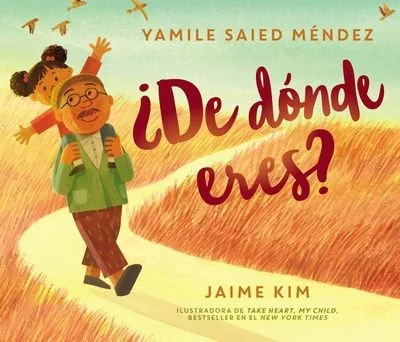
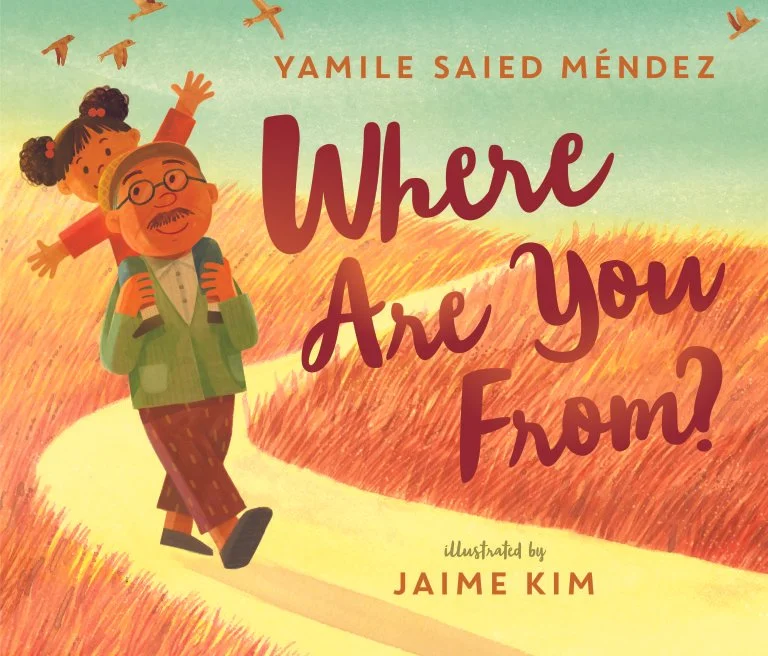
“Where are you from?” The question implies a progression – where did you begin and where are you going? Though often asked out of sheer curiosity, many times it is a loaded question, one whose answer can be used to justify exclusion and discrimination. The girl’s declaration that she is “from here, from today, same as everyone else” is a request to be treated as an equal, as someone who belongs. Once this request is ignored, she retreats to the family that created her, that asks her to justify nothing. The luminous landscapes with skies full of birds and stars suggest the limitless possibilities Abuelo wants for his granddaughter. Though the soaring landscapes could have felt overwhelming, they exude warmth and reassurance. As educators and parents, is this not how we want our kids to feel?
WHERE ARE YOU FROM? could easily have opened with a scene of overt bullying. Instead, the author and illustrator create a more nuanced scenario. The girl is being questioned by a diverse group of kids and adults, all with facial expressions that range from neutral to kind.
By eliminating a stereotypical “villain,” WHERE ARE YOU FROM offers a more realistic depiction of microaggressions endured by children of color (and children with other noticeable differences, such as accented speech).
One of the things I appreciate the most about this book is that we never circle back to the people who questioned the main character at the start. This is an excellent example of what happens when an “own voices” author is allowed to write from their experience. As adult readers, we know the girl will be asked “where are you from?” countless times and ways throughout her life due to the color of her skin. We know that, for some people, her answers will never be right or good enough. By allowing the girl to find an emotional resolution entirely within the context of her support system, WHERE ARE YOU FROM? sends young readers a powerful message: you do not have to justify your existence to others.
For children of mixed heritage, the question “where are you from?” has the power to generate an additional level of self-doubt. A few spreads into the girl’s journey with Abuelo, readers are lulled into the sense that they know where she is from. When Abuelo takes us from Argentina to Puerto Rico we are challenged to open our minds. Like many children, she is not “from” a single place. Rather than simplify (or flatten, or erase) her heritage, WHERE ARE YOU FROM? invites readers to accept the main character’s complex heritage as something that is beautiful to behold.